The Information Design Cycle:
|
 |
Hari Srinivas |
| Policy Analysis Series E-090. June 2015. |
|
Abstract: The Information Design Cycle presents an iterative framework for collecting, organizing, analyzing, packaging, and disseminating information in ways that support effective decision-making and knowledge creation. The document emphasizes that information should not merely be delivered as static content, but designed to enable users to localize, contextualize, and customize it according to their own needs and circumstances. Drawing on lessons from GDRC's experience in knowledge management and developing its online content, the cycle highlights the importance of understanding user needs, identifying interlinkages among information sources, and continuously improving information products through feedback and review. The framework integrates principles of information management, communication, and design thinking to create accessible and meaningful knowledge resources that facilitate learning, awareness, and action across diverse development contexts. |
|
Keywords: Information design, knowledge management, information dissemination, user-centered communication, contextualization, localization, iterative learning, decision-making |
 ackaging information properly so as to facilitate its contextualizing and customizing by the user to create tacit knowledge is an iterative cycle
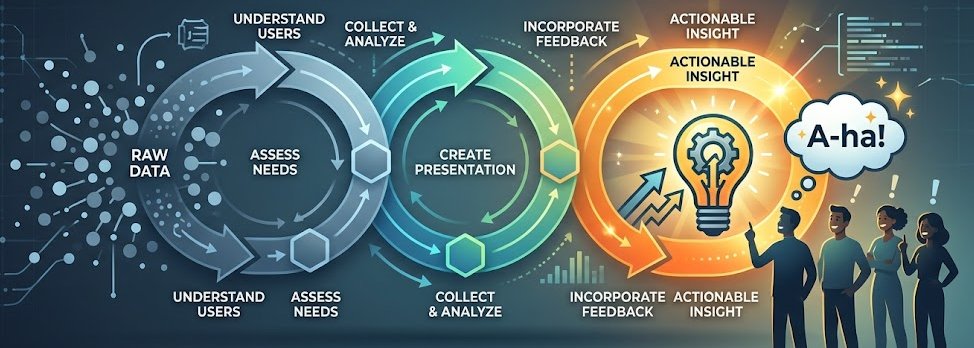
The information design cycle provides a systematic way to move from raw data to actionable insight. It emphasizes understanding users, refining presentation, and using feedback to create clarity and understanding ? the moment when users experience an 'A-ha!' of comprehension.
Based on a user-needs assessment, information is collated and analyzed to build patterns. The iterative process is repeated by incorporating feedback and review it until it matches the needs of the user.

Pre-Cycle: Define Purpose and Audience
What is the purpose of the actions? Who will be audience?Begin by clearly defining what the information is meant to achieve and who it serves. Identify users�f goals, information needs, and decision contexts. Clarifying this purpose early prevents data overload and keeps later design stages focused on what matters most.
Find Information
| Use both primary and secondary sources. Evaluate credibility, bias, and timeliness. Consider open data, citizen-generated content, or crowdsourced information where appropriate. |
In this first stage we prepare to find information by learning about user and target audience - who are they, what are their activities, what kind of decisions they take, what information they need for the decisions, etc.
We then look at sources of information, and the quality and quantity of information that matches the needs of the user. It will also be necessary to look at the timeliness and trustworthiness of information necessary.
It is critical to remember that the information needs of the user may change over time and at different stages of the decision-making process.
Collate and Analyze
| Go beyond data aggregation - identify trends, anomalies, and relationships. Visualization and mapping tools can help reveal hidden patterns. |
Information collected is matched with users' needs by identifying the strengths, weakness, opportunities and threats (commonly called the SWOT analysis methodology).
In this stage, the information is analyzed for the relative advantages it offers, the action it enables, the improvements can be implemented, the opportunities made available, and the obstacles faced.
At this stage, information is only comprehended and categorized for later use. This analysis is essentially non-judgmental and seeks to understand the context where the information is to be used.
Build Patterns
| Translate analysis into meaningful structures ? narratives, models, or conceptual maps. Ask - what story does the information tell? - to make complexity manageable. |
This is where the interlinkages between the different categories and pieces of informantion is identified. There are always problems-behind-problems (that is, a 'visible' problem that is actually caused by another 'invisible' problem), and there are solutions-for-solutions (that is - solutions that lead to more solutions). The collected information should illustrate and relate to such problems and solutions.
The patterns of interlinkages between the different pieces of information highlight such cause-effect relationships. Flowcharts, framework and outlines are created to illustrate these relationships, and identify key points / themes that need to be emphasized.
Pertinent information is hen used to flesh out the outline.
Feedback and Review
| Test drafts or prototypes with representative users. Gather reactions not only to accuracy but to clarity, tone, and emotional resonance. |
A focus group created out of the end-users is created to review the information patterns created in the previous stage. This is important to make sure that the information collated meets the needs of the users.
It also enables channels of information flow to be created to ensure that timely and current information is delivered to the user continuously.
The focus group provides feedback and suggestions for improvement so that the cycle can be improved further. Iteration The information design cycle may be repeated several times iteratively, based on the feedback and review obtained from the focus group, until it meets the users needed requirements.
This is indeed a continual process where new information and changing needs of the user require further analyses and pattern building. This is done in close consultation with the focus group, or directly with the end-users themselves.
Delivery to User
| Choose formats and channels that best match user contexts ? print, web, dashboard, mobile. Ensure accessibility for users with disabilities and multilingual needs. |
The delivery of information to the user should be done carefully - at the right time, to the right user, at the right time and at the right level of governance.
This is critical to ensure that the right decisions are ultimately taken and implemented.
Post-Cycle: Evaluate and Learn
After delivery, monitor how users interact with the information. Did they understand it easily? Did it influence decisions or behavior? Document lessons learned for the next iteration. This closes the loop and strengthens the next cycle.
Where is information available? Who has it? How can we match user needs with information available? What are the interlinakages between the different pieces of information? What enhancements can be envisaged to the info patterns? How can the products developed be improved further? How can the info products be delivered to the user?
These are some of the questions that are covered in the cycle.
The Information Design Cycle is not a linear checklist but a learning process. Each iteration builds better understanding between information creators and users, turning data into shared insight - the true 'A-ha!' moment that drives effective communication and decision-making.
Ultimately, the information cycle illustrated above is an aid to decision-making, of understanding what and how information is used by the target users, and developing a channel to deliver it to the user.
It should make the 'a-ha!' - a spark of insight and inspiration - happen for the user so that the right decision can be taken at the right level at the right time.
|
|

 Hari Srinivas - [email protected] Hari Srinivas - [email protected]Return to the Information Design Page |