At the Crossroads: Urban Inequality, Climate Vulnerability, and the Informal Sector
Hari Srinivas
Policy Analysis Series E-253
Abstract:
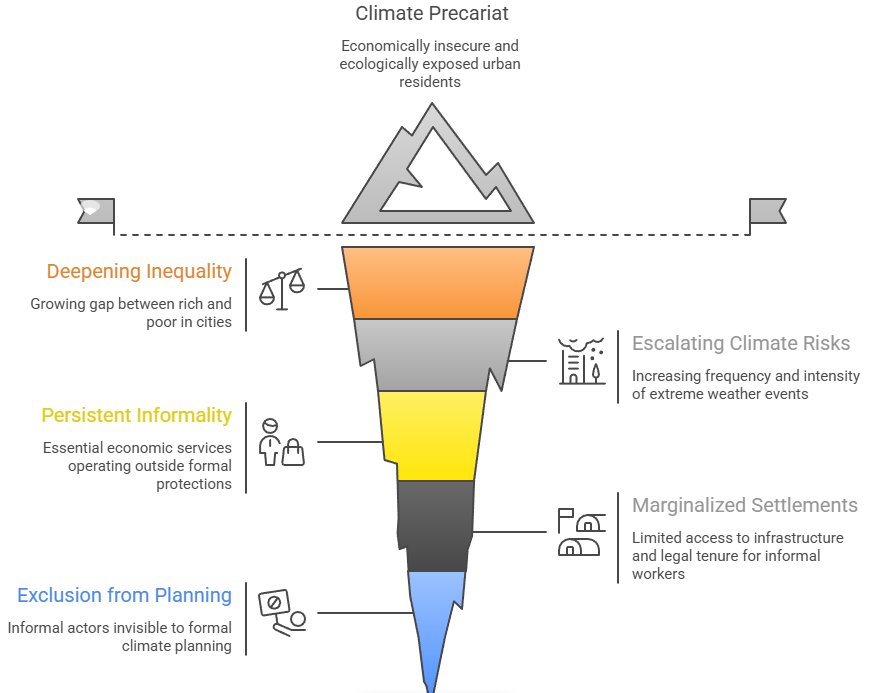
Urban areas sit at the nexus of some of the most pressing challenges of our time: deepening inequality, escalating climate risks, and the persistent growth of informality. These forces are not isolated. They are deeply interconnected, reinforcing each other in ways that compound vulnerability for the urban poor.
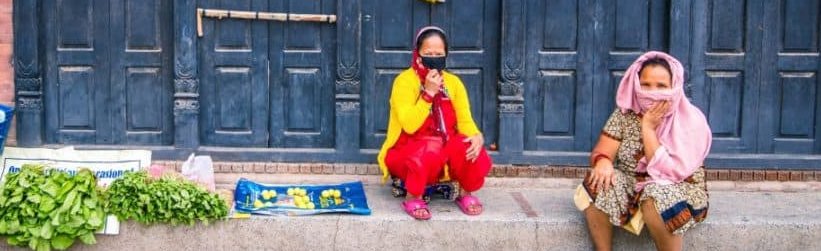
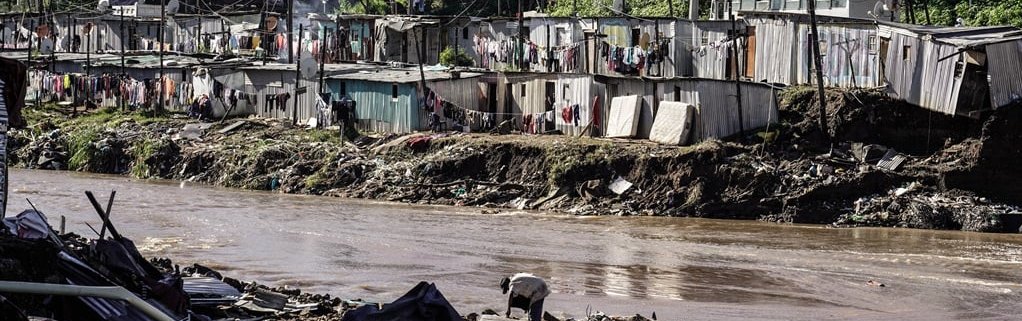
The informal sector-which includes street vendors, waste pickers, construction workers, and many others-provides essential economic services but often operates outside formal protections. These workers typically live in marginalized settlements, in floodplains or on hillsides, with limited access to infrastructure or legal tenure. As climate change accelerates, their exposure to extreme weather events and environmental hazards increases dramatically.
This convergence has created a growing "climate precariat" - urban residents who are both economically insecure and ecologically exposed. They are often invisible to formal climate planning and excluded from access to funding or adaptation measures, despite being vital to urban resilience.
Yet within this crisis lies opportunity. Informal actors are not only vulnerable, they are also resourceful and adaptive. Waste pickers contribute to circular economies, street vendors sustain local food systems, and informal transit workers keep cities moving. Including their voices in climate adaptation and urban planning is both just and practical.
In many cities, the informal sector is not only a major economic force, it is also deeply embedded in systems of urban inequality and climate risk. Informal workers often live and work in high-risk areas such as floodplains, steep slopes, or poorly serviced neighborhoods. Lacking access to basic infrastructure, secure tenure, and social protection, they are disproportionately vulnerable to the impacts of climate change.
As climate-related hazards increase (for example, heatwaves, flooding, storms), informal communities face a double burden: economic insecurity and environmental exposure. Yet, informal actors are also key contributors to urban resilience. Waste pickers, for example, reduce landfill use and emissions; street vendors support local food systems.
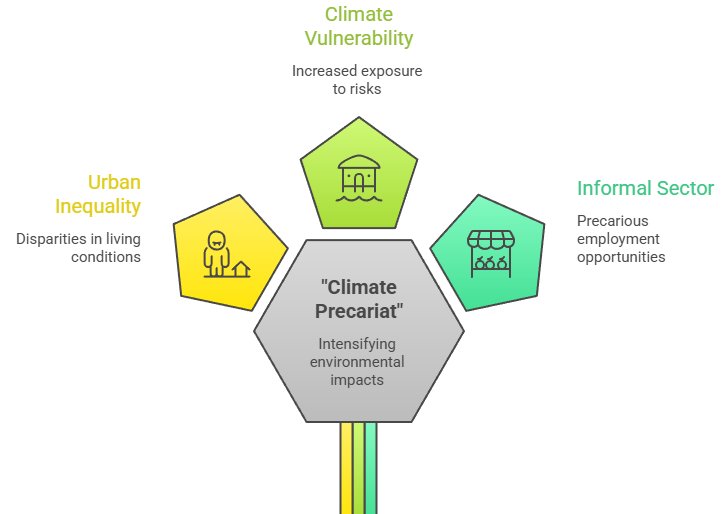
Figure 1: Three factors impacting the emergence of the "Climate Precariat"
Addressing this triple intersection is critical for sustainable urban development. By recognizing, integrating, and protecting informal livelihoods while investing in climate-resilient infrastructure and reducing inequality, cities can become more inclusive, just, and climate-ready.
1. Informality in the Urban Landscape
The informal sector often serves as a coping mechanism for those excluded from formal employment or services, especially in cities with high income inequality.
Informal workers typically live in informal settlements (slums or peri-urban areas), which are underserved in terms of infrastructure, services, and legal protections.
These settlements are spatially and socially marginalized, placing their residents at greater risk during urban or environmental shocks.
In many cities, the informal sector is not only a major economic force, it is also deeply intertwined with patterns of urban inequality and vulnerability to climate change. Informal workers are often excluded from formal employment, legal protections, and social services. They live and work in precarious conditions, and the informal sector becomes a vital coping mechanism for survival in unequal urban systems.
In Mumbai, India, over 50% of the population lives in informal settlements like Dharavi, where poor drainage and cramped living conditions create heightened flood risks during monsoons.
These workers frequently reside in informal settlements that have grown in marginalized spaces, such as floodplains, hillsides, or areas without secure land tenure, where the state fails to provide basic infrastructure and services.
Because of this spatial and social exclusion, their lives and livelihoods are highly exposed to environmental risks and shocks. The lack of legal recognition further complicates efforts to improve their living conditions or integrate them into urban planning.
Examples of Urban Inequality and Vulnerability:
Housing and Infrastructure Deficiencies:
Residents in informal settlements typically lack resources to reduce risk on their own and struggle to access government support or subsidies available to wealthier residents. This is compounded by low public investment in urban infrastructure and basic services. For example, the lack of storm drainage combined with inadequate waste management systems in informal settlements can lead to not only flooding but also contaminated floodwater, causing severe health
impactscompounded, for example, by narrow access roads that limit emergency services access during disasters
Economic Insecurity:
Reliance on insecure work with little or no social protections means that informal workers have limited financial and material assets to recover from adverse climate events. The COVID-19 pandemic, for instance, devastated the livelihoods of 80% of the global informal workforce, highlighting their extreme vulnerability to shocks. Women, in particular, are at higher risk due to their greater exposure to informal employment in more vulnerable categories.
Health Impacts:
Elevated temperatures in cities, exacerbated by the urban heat island effect, can worsen air quality and promote the formation of ground-level ozone. This leads to increased prevalence of heat-related disorders such as dehydration, heat exhaustion, and heatstroke, disproportionately affecting vulnerable populations like the elderly, children, and those with pre-existing conditions.
2. Climate Risks Amplify Urban Inequality
Poor and marginalized urban populations tend to live in high-risk areas (floodplains, unstable hillsides, or heat islands) due to lack of access to safer land.
They have fewer resources to prepare for, respond to, or recover from climate-related events (e.g., heatwaves, flooding, storms).
This reinforces cycles of poverty, displacement, and poor health, amplifying existing urban inequalities.
Urban inequality drives the concentration of low-income groups in hazard-prone environments. The poorest urban residents often have little choice but to settle in areas where land is cheap or unregulated sites that are more vulnerable to flooding, landslides, extreme heat, and other climate-related hazards. These communities rarely benefit from resilient infrastructure like drainage systems, heat mitigation measures, or early warning systems.
In Manila, informal settlements along estuaries face recurring floods due to typhoons, yet are excluded from formal disaster planning.
When disaster strikes, these populations lack the resources to evacuate, rebuild, or recover quickly. Without savings, insurance, or strong safety nets, climate events can trigger a downward spiral of displacement, unemployment, and deeper poverty. As climate change intensifies, the gap between urban rich and poor grows wider, reinforcing systemic disadvantage.
How these factors reinforce each other:
Displacement and Increased Informality:
Climate migration due to extreme events can lead to higher demand for public services and an increase in the population living in informal settlements, further straining resources and exacerbating existing vulnerabilities.
"Green Gentrification":
When protective disaster infrastructure is built in cities, poor households and those in informal settlements may find themselves evicted or more exposed if their communities are not factored into the design. Sustainable building measures can also be expensive, compromising affordability and leading to "green gentrification" where rising house prices exclude low-income residents.
Lack of Data and Inclusion:
Informal settlements and economies are often not routinely included in formal urban and national monitoring, meaning their innovations, concerns, and capacities are not always measured. This exclusion limits their participation in climate planning and access to crucial funding and support.
3. The Climate Sensitivity of Informal Livelihoods
Informal livelihoods: street vending, waste picking, construction, etc., are highly climate-sensitive.
Heatwaves can reduce productivity or even be fatal for outdoor workers.
Flooding can destroy goods and infrastructure used by informal traders.
Because informal workers lack social protections like health insurance or sick leave, climate shocks have disproportionately harmful impacts on them.
Climate mitigation policies (e.g., banning plastic, relocating markets, emissions controls) may also inadvertently harm informal workers if not designed inclusively.
The informal sector itself is highly climate-sensitive. Many informal livelihoods depend directly on weather and climate: think of street vendors, construction workers, waste pickers, domestic workers, or day laborers. Rising temperatures, more frequent floods, or disrupted supply chains all reduce the reliability and safety of informal work. For example, outdoor workers are at greater risk of heatstroke or dehydration during heatwaves, and flooding can destroy
street vending setups or render transport routes impassable.
In Accra, Ghana, women market traders lost significant income during heavy seasonal rains that flooded open-air stalls, with no compensation or support.
Informal workers often lack labor protections, access to healthcare, or recourse to justice if their livelihoods are disrupted.
In this way, climate vulnerability becomes not just an environmental issue but a socio-economic one, where the impacts of climate change are filtered through unequal systems of work and recognition. Climate adaptation policies, if not designed inclusively, can even deepen the problem by displacing informal markets or regulating them out of existence in the name of environmental improvement.
Strategies for Enhancing Resilience and Inclusivity:
Participatory Planning:
Engaging residents of informal settlements in planning processes can provide valuable knowledge and experience for addressing both inequality and climate change. This ensures that interventions reflect local needs and build on community strengths.
Investing in Resilient Infrastructure:
Upgrading informal settlements, strengthening land tenure, and building affordable, low-emission, climate-resilient housing are critical steps. This includes improving access to basic services like water, sanitation, and waste management to mitigate climate-related health risks.
Supporting Informal Livelihoods:
Recognizing and integrating informal livelihoods into urban development strategies can enhance adaptive capacity. For example, initiatives that provide capacity building for organized groups of waste pickers and link them to private recycling companies can improve their business and resilience. However, equitable profit sharing and potential government support for informal sector-led recycling initiatives are crucial to prevent exploitation.
Addressing Health and Livelihood Interconnections:
Policies should consider how climate change affects the health and well-being of informal workers, particularly given their exposure to occupational hazards and poor living environments. Multi-sectoral, co-produced strategies can promote both health and resilient livelihoods simultaneously.
Access to Social Protection and Finance:
Informal workers often lack adequate labor rights and social security, making them highly vulnerable to climate shocks. Access to healthcare, unemployment benefits, and
other social protection measuresFor example, innovative financial mechanisms, such as a Global Climate Resilience Fund for Women, can also help stabilize livelihoods for informal sector women workers and their micro-enterprises. are essential to help them deal with the impacts of a climate crisis.
Strengthening Collective Organization and Representation:
Supporting cooperatives, associations, and unions of informal workers can enhance resilience by improving access to resources, risk-sharing, and collective bargaining. Organized groups are better positioned to engage with authorities, secure climate-resilient workspaces, and ensure that informal workers have a voice in climate and urban policy decisions.
4. A Triple Threat: Compounded Risk and Limited Voices
When urban inequality, climate vulnerability, and informality converge:
... we get a "climate precariat": urban residents who are both economically insecure and ecologically exposed.
These groups are invisible to formal planning and policy, making their needs underrepresented in climate adaptation strategies.
Informal settlements often lack secure tenure, making climate adaptation investments politically and financially difficult, yet they are the areas most in need of resilient infrastructure.
At the intersection of these challenges, we find a compounding risk, a kind of "climate precariat" made up of people who are both economically insecure and ecologically exposed. These groups are routinely overlooked by formal institutions and are underrepresented in policy dialogues. Their informality makes it harder to deliver targeted adaptation support or emergency aid, even though they are the most in need.
Informal settlements, lacking legal land tenure, are often excluded from urban investment, making them more vulnerable to climate risks and less able to build resilience. At the same time, the residents of these communities develop their own adaptive strategies: informal social networks, self-built infrastructure, or community-driven disaster response, that are rarely acknowledged by formal systems.
Table 1: Key Dimensions and Intersections
Dimension
Key Issues
Impacts
Intersections
Urban Inequality
Exclusion from housing, basic services
Greater climate exposure, lower recovery capacity
Pushes low-income groups to hazard-prone areas
Climate Vulnerability
Living in floodplains, heat islands, unstable terrain
High disaster impacts, recurring economic shocks
Disproportionately affects informal settlements
Informal Sector
Precarious, outdoor work; no legal protections
Livelihood losses during climate events
Limited resilience or recovery mechanisms
Policy Gaps
Planning and climate policies exclude informal actors
Missed opportunities for inclusive adaptation
Risk of maladaptation or displacement
Combined Outcome
Climate precariat
Invisible, vulnerable, but crucial to resilience
Need for inclusive, integrated urban responses
5. Why This Intersection Matters
Urban areas are becoming the epicenters of both climate risk and economic disparity. As cities grow, deepening inequality pushes large segments of the population into informal work and precarious housing. At the same time, the impacts of climate change (such as heatwaves, floods, storms, and rising sea levels) are intensifying, often hitting hardest in underserved urban areas where informal workers live and work. These challenges do not occur in isolation: they are tightly interlinked, reinforcing one another in ways that multiply vulnerability for the urban poor.
The informal sector is often seen as a separate economic category, but it is also a social and spatial reality embedded within urban inequality and exposed to climate risk. Understanding this intersection is essential for crafting effective and just urban policies. Without it, climate adaptation efforts risk bypassing or even harming informal communities. With it, cities have an opportunity to address multiple problems at once, enhancing climate resilience, improving livelihoods, and making urban development more inclusive and sustainable.
Addressing this triple intersection is critical for just and resilient urban development. A more inclusive approach means recognizing the rights and contributions of informal workers, investing in resilient infrastructure in marginalized areas, and designing climate adaptation policies that actively reduce, not exacerbate, urban inequality. With coordinated action across sectors and scales, cities can become more climate-ready, more equitable, and more human-centered.
6. Building Inclusive and Climate-Resilient Cities
Despite the risks, this intersection also offers opportunities for transformative urban policy:
Co-production of resilience strategies with informal communities can build trust and improve outcomes.
Upgrading informal settlements with green infrastructure can improve both climate resilience and social inclusion.
Supporting the informal economy through recognition, protection, and integration into urban planning can boost both livelihoods and sustainability.
Despite these challenges, the intersection of urban inequality, climate vulnerability, and the informal sector is also a space of opportunity. Recognizing and working with informal communities can open up pathways to more inclusive and effective urban climate strategies. Community-based upgrading, participatory planning, and investment in locally-driven resilience measures can address multiple risks at once.
In Medellín, Colombia, participatory planning helped upgrade hillside informal settlements using cable cars and green infrastructure to reduce landslide risks.
Moreover, informal workers are not just vulnerable, they are also key actors in building sustainable cities. Waste pickers reduce landfill use and support circular economies; street vendors help maintain affordable, localized food systems; informal transport providers keep cities moving. Including their voices and needs in urban climate policies is not only a question of equity, but also a smart, pragmatic strategy for sustainability.
Figure 2: Urban Vulnerability: The Interconnected Challenges
7. Policy recommendations:
1.Recognize and Protect Informal Livelihoods
Informal workers play a vital role in the urban economy, providing essential goods and services such as food distribution, waste management, and construction. However, their contributions often go unrecognized in formal policy and planning processes. Legal recognition and protection of informal livelihoods is a foundational step toward inclusive climate adaptation. This includes extending labor rights, occupational safety, and access to services like healthcare and childcare. Policies must also guard against the criminalization of informal work, particularly during climate-related urban interventions. Recognizing the economic and environmental value of informal actors, and integrating them into planning, will strengthen both social equity and urban resilience.
2.Invest in Resilient Infrastructure in Marginalized Areas
Informal settlements are often situated in environmentally hazardous locations such as floodplains, unstable slopes, or heat islands. These areas are rarely prioritized in urban infrastructure development, leaving them highly vulnerable to climate shocks. Public investment in upgrading these areas with climate-resilient infrastructure, such as storm drainage systems, heat mitigation (e.g., urban greening), solid waste services, and safe water supply, is critical. Resilient infrastructure must be affordable, locally appropriate, and implemented with community input. Upgrading should be paired with secure tenure arrangements to avoid displacement. Such investments not only reduce exposure to climate hazards but also improve health, dignity, and economic opportunities for residents.
3.Engage Communities in Co-Producing Climate Responses
Inclusive climate action must begin with the knowledge, priorities, and lived experiences of those most at risk. Informal communities often have deep contextual understanding of environmental risks and have developed local coping strategies. Co-production, where communities actively collaborate with government, NGOs, and planners-ensures that climate policies and projects are relevant and effective. Participatory mapping, community-led design, and inclusive decision-making forums enable marginalized voices to shape adaptation efforts. This approach builds local ownership, increases the sustainability of interventions, and fosters trust between residents and institutions. Cities that prioritize co-production are more likely to achieve equitable and enduring resilience outcomes.
4.Include Informal Economies in Urban Data and Planning
A significant barrier to inclusive urban governance is the lack of systematic data on informal settlements and workers. Many informal neighborhoods do not appear on official maps, and informal workers are not counted in economic surveys or labor statistics. This invisibility results in their exclusion from infrastructure projects, social programs, and emergency responses. Governments and institutions should prioritize participatory data collection, such as community-driven mapping or inclusive household surveys. Integrating this data into urban plans and climate risk assessments will improve targeting and resource allocation. Recognizing the informal sector within official policy frameworks is essential for ensuring that adaptation measures do not bypass or unintentionally harm the most vulnerable groups.
5.Provide Social Protection and Access to Climate Finance
Informal workers are among the least protected when climate disasters strike. They often lack access to health insurance, unemployment benefits, or financial safety nets, making recovery slow and uncertain. Expanding social protection to informal workers is a critical component of climate resilience. This includes extending eligibility for cash transfers, health coverage, and emergency aid to unregistered workers and residents of informal settlements. Simultaneously, cities and development partners should develop innovative climate finance mechanisms that directly benefit informal communities, such as community adaptation funds or gender-focused micro-grants. When combined, these measures can stabilize incomes, prevent downward mobility, and create the conditions for long-term, climate-resilient development.
This work by GDRC is licensed under a Creative Commons
Attribution-ShareAlike 4.0 International License. You are free to share and adapt this piece of work for your own purposes, as long as it is appropriately cited.
More info: http://creativecommons.org/licenses/by-sa/4.0/
on


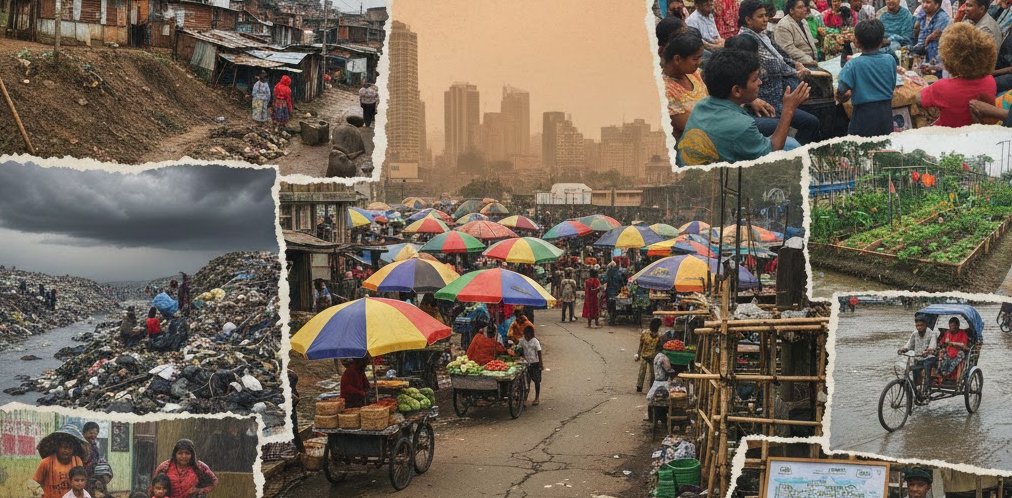
 In Mumbai, India, over 50% of the population lives in informal settlements like Dharavi, where poor drainage and cramped living conditions create heightened flood risks during monsoons.
 In Manila, informal settlements along estuaries face recurring floods due to typhoons, yet are excluded from formal disaster planning.
 In Accra, Ghana, women market traders lost significant income during heavy seasonal rains that flooded open-air stalls, with no compensation or support.
 In Medellín, Colombia, participatory planning helped upgrade hillside informal settlements using cable cars and green infrastructure to reduce landslide risks.