
From Grassroots to Global:
The Diverse Contributions of NGOs
Hari Srinivas Explainer Series C-110
NGOs or Non-Governmental Organizations are best understood by what they are not - they are not governmental, they do not make a profit, or are not partisan/sectarian. In general, an NGO is (a) formally or informally organized around shared purposes; (b) nongovernmental, and so not part of the state apparatus; (c) self-governing, rather than externally controlled; (d) voluntary both in the sense of being non-compulsory, and involvement in their governance or operations, and (e) non-profitAny profits that may be generated is plouged back into the NGO's existing or future activities. in its financial assets.
Recognizing the importance of understanding the nature of NGOs and their activities, the NGO Cafe has devoted a whole section on defining NGOs: "NGO Pigeon Holes." A number of documents in this section explore in detail the various definitions and types.
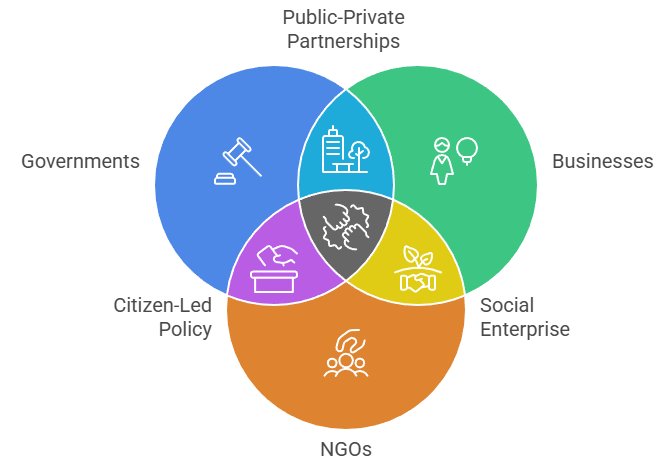
Figure 1: Stakeholder Position of NGOsThroughout the Cafe, the term NGO is used in a very generic sense and includes most of its variations and forms. While there are a number of variations to the definition of NGOs, here it is taken to mean small NGOs, focussing on activities in developing countries, operating at the local level in cities and towns, and targeting low-income groups for their development.
Why focus on NGOs?
NGOs play a critical role in society because they form the third major stakeholder group in public affairs, complementing governments and businesses. Together, these three sectors shape how policies are made, how services are delivered, and how communities respond to emerging challenges. Governments carry the mandate of authority, businesses bring resources and innovation, and NGOs contribute perspectives rooted in people, participation, and public interest.
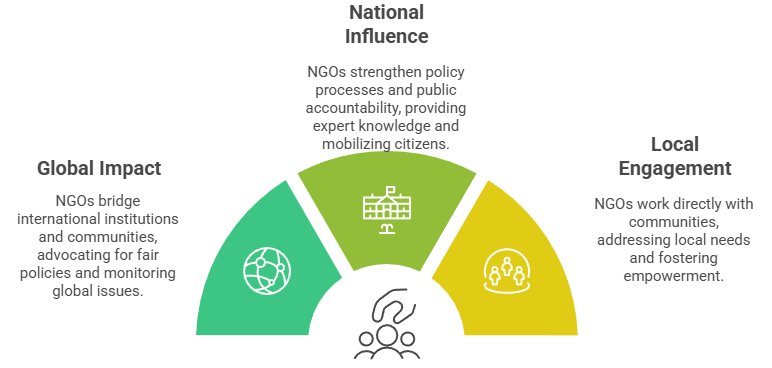
Figure 2: The Global, National and Local Dimensions of NGOsAt the global level, NGOs help bridge gaps between international institutions and real communities. They place local concerns on global agendas, advocate for fair and accountable policies, and act as watchdogs on issues such as climate change, human rights, sustainable development, and humanitarian relief. Their presence in global networks ensures that debates are not driven only by political or commercial interests, but also by social justice, equity, and environmental responsibility.
At the national level, NGOs strengthen policy processes and public accountability. They provide expert knowledge, mobilize citizens, monitor the delivery of public services, and highlight the needs of groups who may otherwise remain unheard. Many national governments increasingly rely on NGOs to pilot new approaches, deliver social programs, and bring evidence of what works and what does not. Their independence allows them to question policy choices, propose alternatives, and hold institutions to account.
At the local level, NGOs are closest to the ground realities. They work directly with communities, understand their needs and constraints, and help people organize, participate, and take action. Because they operate within neighborhoods, towns, and rural areas, they can respond quickly to emerging problems, tailor solutions to local contexts, and build trust with groups who may be marginalized or overlooked. Their grassroots orientation enables them to foster empowerment, strengthen social capital, and support sustainable, community-driven change.
In this way, NGOs are needed not only for the services they deliver, but also for the values they represent: participation, inclusion, accountability, and community engagement. By balancing the roles of governments and businesses, NGOs help shape a more responsive and equitable society, ensuring that development is grounded in the needs and aspirations of people.
The Roles of NGOs
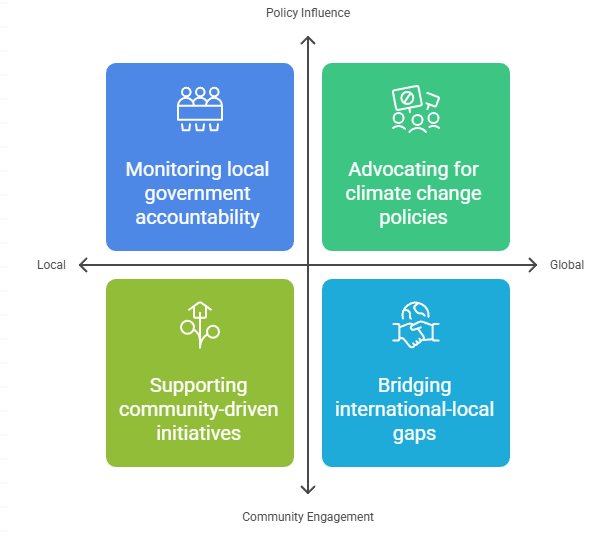
There are four broad roles that NGOs play across two dimensions: their degree of policy influence and their level of community engagement. By placing these roles on a grid that moves from local to global, and from grassroots action to formal policy advocacy, the diagram shows the diversity and flexibility of NGO work.
Figure 3: A Dual-Axis Grid of the Roles of NGOsIn the upper left, monitoring local government accountability reflects the role of NGOs in strengthening transparency and supporting oversight at the municipal or district level. These activities require policy awareness and active engagement with local authorities.
In the upper right, advocating for climate change policies captures how NGOs can operate at a global scale. Here the emphasis is on shaping national and international agendas, engaging in research, participation in global forums, and pushing for stronger commitments on issues that affect people everywhere.
In the lower left, supporting community driven initiatives highlights the grassroots foundation of many NGOs. This quadrant shows how NGOs help communities organize themselves, mobilize resources, and design solutions that address their own needs and priorities.
In the lower right, bridging international local gaps represents the linking role that many NGOs play. They translate global goals into local action, connect international donors or institutions with community realities, and help ensure that global programs remain grounded in on the ground experience. Together, the four roles show how NGOs work across scales and functions, combining advocacy, service delivery, community empowerment, and knowledge sharing to create more responsive and inclusive development processes.
And what is the NGO Cafe? Realizing the growing importance and voice of NGOs in development, the NGO Caf�Ewas set up on the internet as a meeting place for NGOs to discuss, debate and disseminate information on their work, strategies and results.
The objectives of the NGO Cafe are:
- To assist NGOs in enhancing and improving their programmes and activities
- To effect a better understanding of NGOs in general
- To enable NGOs to network at local, regional and international levels, horizontally and vertically


Return to the NGO Page
Comments and suggestions:
Hari Srinivas - [email protected]