
The Third Leg of Climate Policy:
Facilitating an Ecosystem for Climate Technologies
 |
Hari Srinivas |
| Policy Analysis Series E-249. |

|
Abstract: This paper positions technology as the third leg of climate policy and action, alongside governance and education. It argues that effective climate technologies do not emerge in isolation but require a supportive ecosystem that links clear public direction, strong research and skills, innovation infrastructure, and broad based adoption. By presenting a structured framework of twelve essential elements across governance, knowledge, innovation, and collaboration, the paper outlines how countries and cities can cultivate environments where climate solutions can be developed, tested, financed, and scaled. Strengthening this technological leg ensures that climate governance becomes actionable and that climate education translates into practical, system wide transformation. |
|
Keywords: climate technology ecosystem, climate governance, climate education, innovation systems, green investment, research and skills, community adoption, international cooperation |
INTRODUCTION
B
uilding an ecosystem for climate technologies requires more than isolated research or individual projects. It needs a coherent environment in which ideas can emerge, be tested, and eventually reach the people and institutions that need them most. Climate change is a system wide challenge, so the technologies that address it must develop within a system that supports innovation, financing, collaboration, and long term commitment.Such an ecosystem draws on multiple strengths. It depends on clear public direction, an active research community, access to finance, a skilled workforce, and the participation of industries, communities, and global partners. No single actor can build this alone. Governments set the enabling conditions, but the energy comes from entrepreneurs, researchers, utilities, industries, and civil society working together in a coordinated way.
Technology as the Third Leg of Climate Policy and Action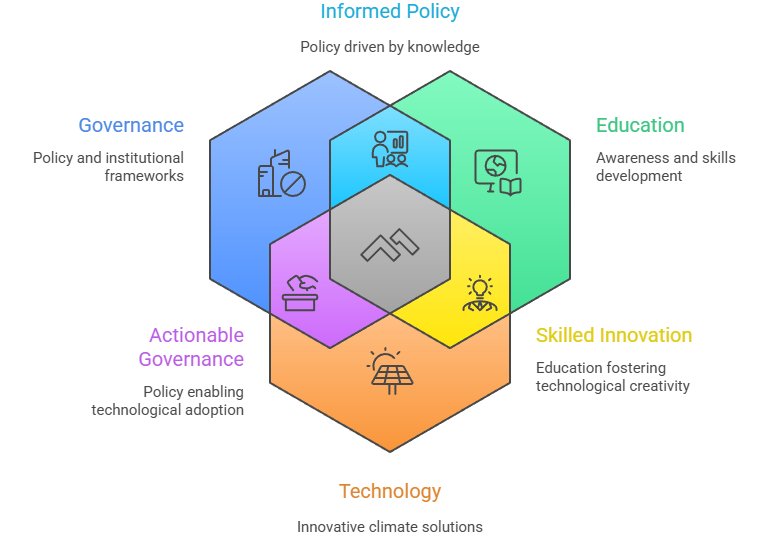 Figure 1: The Three Legs of Climate Policy and Action Technology forms the third leg of climate policy and action, complementing governance and education in the GET Matrix. While governance establishes mandates, priorities, and enabling rules, and education builds awareness, skills, and societal readiness, technology provides the practical tools that turn ambition into measurable progress. Effective climate action depends on all three legs functioning together: clear direction, informed and capable actors, and technologies that can be deployed, scaled, and sustained. For technology to play this role, it must grow within a supportive ecosystem that links research, innovation, finance, and adoption. Such an ecosystem enables ideas to move from laboratories to communities and industries, supported by regulations that shape fair markets, training systems that build technical capacity, and financing structures that carry solutions across each stage of development. When these elements align, technologies become not just products but enablers of systemic change across energy, mobility, food, water, buildings, and waste systems. Positioning technology as the third leg highlights its catalytic role. It reminds policymakers and practitioners that climate technologies do not emerge or spread on their own. They require institutions that set direction, people who understand and trust them, and partnerships that carry them into real world use. Strengthening this leg ensures that climate strategies become operational, that climate education becomes actionable, and that climate governance becomes effective in practice. |
A well formed ecosystem therefore links policy, knowledge, innovation, and adoption into a continuous cycle. Priorities inform research. Research fuels innovation. Innovation draws investment. Investment enables deployment. Deployment generates learning, which feeds back into better policies and stronger technologies.
The following framework lays out twelve essential components arranged under four parts, showing how they come together to build a robust climate technology ecosystem.
Why "ecosystem"?
| Original meaning | An ecosystem is a dynamic community of living organisms interacting with each other and with their physical environment as a unified system. Energy flows, material cycles, and biological relationships connect all components, allowing the system to sustain itself and adapt to changing conditions. |
| Broader meaning for this document | In the context of climate technology, an ecosystem refers to the interconnected network of policies, institutions, skills, financing, partnerships, and users that enable technologies to emerge, evolve, and spread. Just as in nature, its strength comes from the quality of relationships among its parts. When direction, knowledge, innovation, and adoption work together, the ecosystem supports continuous learning, reduces barriers, and creates conditions where climate solutions can scale and deliver system wide impact. |
The Climate Technology Ecosystem
The development of climate technologies requires more than individual innovations or isolated policy interventions. It depends on a structured ecosystem in which ideas can be generated, tested, financed, and ultimately adopted at scale. Such an ecosystem brings together public direction, knowledge creation, innovation support, and broad based collaboration, ensuring that technologies move beyond pilots and become part of everyday economic and social systems.
| PART 1. Governance and Direction | PART 2. Knowledge and Talent Base |
|---|---|
|
1. Climate goals and priority setting 2. Regulations, standards, and market signals 3. Public sector leadership and green procurement |
4. Research institutions and universities 5. Technical skills and workforce development 6. Open data, shared learning, and knowledge networks |
| PART 3. Innovation and Financing | PART 4. Adoption and Collaboration |
|
7. Testbeds, pilots, and demonstration zones 8. Incubators, accelerators, and startup support 9. Financing across the innovation chain |
10. Industry partnerships and early adopters 11. Community engagement and social acceptance 12. International cooperation and cross border scaling |
The four parts outlined here represent the core functional pillars of this ecosystem. Governance and direction provide clarity, stability, and demand signals that shape innovation pathways. Knowledge and talent form the human and institutional foundation, ensuring that research, skills, and learning are continuously renewed. Innovation and financing enable experimentation and growth by reducing risk and mobilizing resources across the technology life cycle. Adoption and collaboration connect technologies to real world users, markets, and communities, allowing solutions to scale and generate impact.
Together, these four parts should be seen not as sequential stages but as interdependent components of a living system. Weakness in any one part can limit the effectiveness of the others, while strong alignment across all four accelerates learning, investment, and deployment. Framing climate technology development through this ecosystem lens helps policymakers, practitioners, and partners identify gaps, coordinate actions, and strengthen the third leg of climate policy and action alongside governance and education.
PART 1 |
Governance and Direction |
A strong climate technology ecosystem begins with clear guidance from public institutions. When national and local governments articulate long term climate goals and sectoral priorities, they give innovators and investors confidence on where the country is headed. Effective regulations and standards reinforce this direction by shaping markets that reward cleaner and more efficient solutions, while stable instruments such as carbon pricing and green procurement create predictable demand. Public sector agencies can then act as early adopters by piloting new technologies in energy, transport, buildings, water, and waste services, reducing risk for innovators and demonstrating what is possible in real world conditions.
- Climate goals and priority setting
Sets the long term pathway for transformation and signals where innovation is most needed. - Regulations, standards, and market signals
Creates fair, predictable markets that reward low carbon solutions. - Public sector leadership and procurement
Uses public demand to pull new technologies into real world use.
1. Climate goals and priority setting
Clear long term climate goals give direction to innovators, investors, and public agencies. When governments set measurable targets for emissions, energy, transport, agriculture, and waste, they create a predictable environment for climate technologies to emerge and scale.- Main goals and priorities: Define national and local climate pathways, sectoral priorities, and measurable targets.
- Responsible actors: National ministries, local governments, climate councils, and planning authorities.
- Targets and beneficiaries: Technology developers, private investors, public agencies, and communities that benefit from a clear policy signal.
2. Regulations, standards, and market signals
Effective rules help new technologies enter the market and encourage investment. Standards, carbon pricing, and green procurement create demand for cleaner options without forcing specific technologies.- Main goals and priorities: Ensure environmental integrity, create fair markets, and support new low carbon solutions.
- Responsible actors: Regulators, standards bodies, procurement agencies, and legislators.
- Targets and beneficiaries: Industry, startups, public institutions, and consumers who benefit from cleaner and more reliable solutions.
3. Public sector leadership and procurement
Governments can accelerate climate technology by acting as early adopters. When cities and agencies procure clean energy, mobility, or waste solutions, they reduce risk for innovators and help new ideas mature.- Main goals and priorities: Use public budgets to pull emerging technologies into real world use.
- Responsible actors: National and local authorities, public utilities, and procurement units.
- Targets and beneficiaries: Technology suppliers, local firms, and citizens who receive improved public services.
PART 2 |
Knowledge and Talent Base |
Climate innovation depends on a strong foundation of research, skills, and shared learning. Universities and research institutes generate the knowledge needed to understand problems and craft new solutions, and their collaborations with industry accelerate applied innovation. Training systems in schools, technical colleges, and professional bodies prepare the engineers, technicians, and operators who design, install, and maintain climate technologies at scale. Open data, knowledge networks, and platforms for shared learning make this ecosystem more efficient by reducing duplication, enabling evidence based decisions, and allowing ideas to spread quickly across sectors and regions.
- Research institutions and universities
Provide scientific foundations and drive early stage experimentation. - Technical skills and workforce development
Prepare the engineers, technicians, and operators who make climate technologies work. - Open data, shared learning, and knowledge networks
Spread ideas, reduce duplication, and support evidence based policies.
4. Research institutions and universities
Strong research organisations provide the scientific base for climate innovation. They generate knowledge, test ideas, and build partnerships with industry and government.- Main goals and priorities: Produce research, advance climate science, and support applied innovation.
- Responsible actors: Universities, laboratories, research councils, and academic funding agencies.
- Targets and beneficiaries: Students, researchers, startups, and companies that use new knowledge.
5. Technical skills and workforce development
A skilled workforce is critical for designing, manufacturing, installing, and maintaining climate technologies. Training systems need to prepare technicians, engineers, and operators at scale.- Main goals and priorities: Build human capacity across engineering, digital, and maintenance skills.
- Responsible actors: Education ministries, technical colleges, vocational institutions, and industry groups.
- Targets and beneficiaries: Workers, students, employers, and communities needing local green jobs.
6. Open data, shared learning, and knowledge networks
Shared data and learning platforms accelerate innovation by reducing duplication and enabling evidence based decisions. Knowledge exchange supports both early research and market adoption.- Main goals and priorities: Improve transparency, support experimentation, and enable collaboration.
- Responsible actors: Research institutions, city governments, standards bodies, and public data agencies.
- Targets and beneficiaries: Innovators, analysts, policymakers, and civil society groups.
PART 3 |
Innovation and Financing |
To move from ideas to market ready solutions, innovators need supportive environments in which to experiment and grow. Testbeds, pilot projects, and demonstration zones allow new technologies to be trialed under real conditions, helping refine designs and reduce uncertainty for regulators and investors. Incubators, accelerators, and entrepreneurial support programs provide mentorship, technical guidance, and access to customers, shortening the path from concept to commercial product. Financing that matches each stage of innovation is essential, from research grants and seed funding to blended finance, venture capital, and public investment that help promising technologies scale.
- 7. Testbeds, pilots, and demonstration zones
Offer safe spaces to test emerging technologies under real conditions. - 8. Incubators, accelerators, and startup support
Help entrepreneurs turn concepts into deployable products. - 9. Financing across the innovation chain
Mobilizes capital from grants to commercial investment for each stage of development
7. Testbeds, pilots, and demonstration zones
Pilot zones allow climate technologies to be tested at small scale under real conditions. These sites reduce uncertainty and help innovators refine their solutions before wider deployment.- Main goals and priorities: Validate performance, collect data, and reduce adoption risk.
- Responsible actors: Local governments, utilities, industrial parks, and innovation agencies.
- Targets and beneficiaries: Startups, researchers, regulators, and local communities engaged in pilots.
8. Incubators, accelerators, and startup support
Support programs help early stage climate innovators turn ideas into products. They offer mentorship, technical advice, regulatory guidance, and links to potential customers.- Main goals and priorities: Strengthen entrepreneurship and shorten the journey from concept to market.
- Responsible actors: Incubators, accelerators, venture capital partners, and industry hubs.
- Targets and beneficiaries: Startup founders, small firms, and local innovation ecosystems.
9. Financing across the innovation chain
Climate solutions require blended financing from research grants to commercial capital. Each stage needs appropriate instruments to match risks and timelines.- Main goals and priorities: Mobilize investment, reduce financial risk, and support scaling.
- Responsible actors: Public funding agencies, development banks, private investors, and philanthropic funds.
- Targets and beneficiaries: Innovators, companies, municipalities, and users of climate technologies.
PART 4 |
Adoption and Collaboration |
Even the best technology succeeds only when it is embraced by users, industries, and communities. Partnerships with established companies and utilities help integrate new ideas into large scale systems and supply chains, providing operational feedback and market access. Community engagement builds trust, ensures fairness, and aligns solutions with local preferences, which is especially important in energy transitions, land use changes, and environmental projects. International cooperation finally helps spread successful models by harmonising standards, sharing research, and opening regional markets, making it easier for climate technologies to move across borders and accelerate global progress.
- Industry partnerships and early adopters
Integrate new solutions into large scale systems and supply chains. - Community engagement and social acceptance
Ensure technologies fit local needs and build trust among users. - International cooperation and cross border scaling
Spread successful solutions and align standards for wider adoption.
10. Industry partnerships and early adopters
Established firms play a key role by adopting and integrating new technologies into large systems. Their operational experience and market reach can accelerate scaling.- Main goals and priorities: Strengthen industry innovation, build supply chains, and validate new solutions.
- Responsible actors: Corporations, utilities, transport operators, agribusinesses, and manufacturers.
- Targets and beneficiaries: Startups, suppliers, customers, and entire value chains.
11. Community engagement and social acceptance
Climate technologies succeed only when communities trust them. Engagement ensures technologies are relevant, equitable, and aligned with local needs and cultural contexts.- Main goals and priorities: Improve acceptance, address concerns, and support fair access to benefits.
- Responsible actors: Local governments, community groups, NGOs, and project developers.
- Targets and beneficiaries: Households, neighborhoods, vulnerable groups, and local service users.
12. International cooperation and cross border scaling
Collaboration across borders helps countries share knowledge, align standards, and pool resources. Global partnerships make it easier for climate technologies to scale across regions.- Main goals and priorities: Reduce cost, harmonise standards, and expand markets for climate solutions.
- Responsible actors: National governments, multilateral institutions, global research networks, and regional blocs.
- Targets and beneficiaries: Innovators seeking new markets, governments seeking proven solutions, and global communities benefiting from faster climate progress.
WAY FORWARD
Looking ahead, the development of climate technologies requires continuous coordination among policy makers, researchers, investors, and communities. Policy alone cannot drive innovation, and technology alone cannot solve climate challenges without supportive social and economic structures. The ecosystem approach encourages different actors to see their roles as interconnected parts of a larger transformation, rather than as isolated efforts.The priority now is to deepen collaboration and reduce fragmentation. This means aligning national strategies with local implementation, linking research funding with entrepreneurial pathways, and ensuring that community needs shape the design and adoption of new technologies. It also means strengthening financing mechanisms that share risks fairly across public and private actors, especially in early and uncertain stages of innovation.
Ultimately, a successful climate technology ecosystem must be both ambitious and inclusive. It must support bold experimentation while ensuring that benefits reach all sections of society. As the impacts of climate change intensify, the need for coordinated, well supported innovation becomes even more urgent. Building this ecosystem is not just an investment in technology, but an investment in resilience, equity, and long term sustainability.
|
CITATION TEXT:
|

 |
Return to Technology Management Comments and suggestions to - [email protected] |