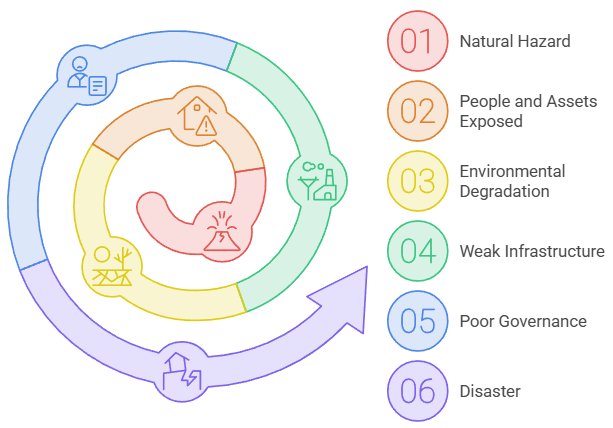
Disasters are no longer viewed as isolated events caused solely by nature. They are increasingly understood as the outcome of interactions between natural hazards, environmental degradation, rapid urbanization, weak governance, climate change, and social vulnerability.
Understanding these interactions is the first step toward reducing disaster risk and building resilient communities. Effective disaster management therefore combines scientific knowledge, environmental planning, social preparedness, and institutional cooperation.
The high density of cities and human settlements make them particularly vunerable to disasters and hazards. Not a week goes by without news of a disaster, natural or man-made, effecting huge losses on humans and the environment as a whole.
Disasters are becoming more complex, where a range of multiple factors in the social, cultural and natural spheres are increasing the risks associated with disasters.
Figure 1: Natural Hazards and Disasters Flow
The well known saying on health, of "Prevention is better than cure", can very much be applied to disaster management as well. It is increasingly becoming apparent that planning and preparedness, prevention, mitigation, response and relief, and recovery, to tackle disasters are critical in order to reduce the negative impacts and effects of such events.
Table 1: Disaster Concepts
Concept
Meaning
Hazard
A potentially damaging natural or human-induced event, process, or phenomenon that may cause loss of life, injury, property damage, environmental degradation, or social and economic disruption.
Exposure
The presence of people, buildings, infrastructure, livelihoods, ecosystems, or other assets in areas that could be affected by hazards.
Vulnerability
The physical, social, economic, or environmental conditions that make people, communities, or systems more susceptible to the impacts of hazards.
Capacity
The strengths, resources, knowledge, skills, and institutions available to individuals or communities that enable them to anticipate, cope with, respond to, and recover from disasters.
Risk
The likelihood of harmful consequences resulting from the interaction of hazards with exposed and vulnerable people, assets, and systems.
Resilience
The ability of individuals, communities, organizations, or systems to prepare for, withstand, adapt to, and recover quickly from disasters while maintaining essential functions.
The role of communities and individual families in taking appropriate action to mitigate disaster impacts has been recognizedThis was a key lesson emerging from the recovery of Kobe city in Japan after the 1995 Great Hanshin-Awaji Earthquake as important:
Local governments and emergency services realize that response to an emergency situation can be hampered by the disaster itself
Relief can best be delivered by those closest at hand.
Community-based disaster management is now becoming an integral part of any local or national disaster management planning,
Table 2: Natural and Human-induced Hazards
Natural Hazards
Human-induced Hazards
Geological
Earthquakes
Volcanic eruptions
Tsunamis
Landslides
Avalanches
Hydrological
River floods
Flash floods
Coastal flooding
Storm surges
Meteorological
Tropical cyclones
Typhoons
Hurricanes
Tornadoes
Severe thunderstorms
Lightning
Hailstorms
Heatwaves
Cold waves
Blizzards
Climatological
Drought
Wildfires
Desertification
Dust storms
Biological
Epidemics
Pandemics
Plant diseases
Animal diseases
Locust and pest outbreaks
Industrial and Technological
Chemical spills
Industrial explosions
Oil spills
Nuclear accidents
Mine accidents
Dam failures
Urban and Infrastructure
Urban fires
Building collapse
Bridge failure
Power outages
Water supply failures
Transportation accidents
Environmental
Deforestation
Land degradation
Air pollution episodes
Water contamination
Hazardous waste incidents
Social and Political
Armed conflict
Civil unrest
Terrorism
Forced displacement
Refugee crises
Emerging Risks
Cyber attacks on critical infrastructure
Supply chain disruptions
Infrastructure system failures
Complex cascading emergencies
Understanding hazards and disasters are important due to a number of myths that still exist:
Myth: Natural disasters are unavoidable
⤷Reality: Hazards cannot always be prevented, but disasters can often be reduced
Myth: Relief is the most important activity ⤷Reality: Prevention saves more lives and costs less
Myth: Technology alone solves disasters ⤷Reality: Governance and community participation are equally important
Myth: Recovery means returning to normal
⤷Reality: Recovery should reduce future risk
Myth: Only governments manage disasters
⤷Reality: Communities, businesses and civil society all play critical roles
Lessons in disaster management are emerging, albeit unfortunately after a disaster has struck:
Build local community capacity
It is important to support and build local capacities for people to mitigate and prevent disasters, and cope with post-disaster impacts. Such capacities will also enable communities to cope better with those few disasters which are unavoidable.
Create partnerships and alliances
There are a number of organizations and groups that are involved, or need to be involved, in disaster management. It is important to build participatory alliances and partnerships among these entities in order to map out responsibilities and activities.
Share and exchange information
Knowledge embedded in different organizations and groups need to be recorded and shared among all of them, and used for different purposes. This is particularly true of universities and research institutions in the region where disasters occur. Regular learning opportunities are critical for communities to understand, experience and prepare themselves for a disaster.
Develop learning and decision-making tools
existing knowledge and understanding of disasters, man-made and natural has to be used to develop learning and decision-making tools that can be used for disaster mitigation, including the creation of disaster maps, mitigation plans etc.
Key Takeaways
Hazards do not automatically become disasters.
Vulnerability determines the severity of impacts.
Good environmental management reduces disaster risk.
Prevention is more cost-effective than response.
Climate change is altering disaster patterns.
Communities are the first responders.
Recovery should build greater resilience.
Disaster risk reduction is an essential component of sustainable development.