
Sites and Services:
|
 |
Hari Srinivas |
| Concept Note Series E-152. April 2022. |
|
Abstract: The sites-and-services approach emerged as a practical response to the challenges of urban housing shortages in developing countries. Recognizing the limitations of state-led provision of complete housing units, this strategy focuses on supplying land plots equipped with basic infrastructure, allowing low-income families to build their homes incrementally using their own resources. Initially promoted by the World Bank and widely adopted across Asia, Africa, and Latin America, sites-and-services schemes have demonstrated both potential and pitfalls. While they empower households, encourage self-help, and reduce public costs, they also face challenges of affordability, bureaucratic inefficiency, inadequate infrastructure provision, and poor cost recovery. Despite mixed results, the approach remains a significant model for enabling governments and communities to collaborate in achieving affordable, sustainable urban housing.
Keywords: |
Within a wide variety of types and variations, "Sites-and-Services" schemes are the provision of plots of land, either on ownership or land lease tenure, along with a bare minimum of essential infrastructure needed for habitation to meet the housing needs of low-income urban households.
The realization that providing a "complete" serviced house by government agencies is not possible or simply cannot be afforded by most low-income families prompted a shift in focus from supplying a fully serviced house to that of providing only serviced land. The key characteristic of the approach the use of the beneficiaries' "sweat equity" and other internal resources (community, financial and so on) in the actual construction and development of the houses.
Sites-and-services schemes became the byword for solving the problem of squatter settlements. Squatter settlements were and has always been considered illegal and in order to relocate and rehabilitate the squatters (as a function of "slum clearance"), plots of land (or sites) with infrastructure on it (or services) were provided, and the beneficiaries had to, in most of the projects, build their own houses on such land. There are a wide variety of sites-and-services schemes, ranging from the subdivided plot only to a serviced plot of land with a "core" house built on it.
Particularly in face of the failure of the conventional housing approaches, coupled with a number of studies that pointed out the ingenuity and perseverance of squatters to house themselves, providing sites and services only was touted as a answer to the problems of housing the poor in developing cities. Many countries in South America, Asia and Africa took up this concept, and with the World Bank strongly advocating this approach and providing key finance for a number of projects, the idea received widespread approval.
Sites-and-services schemes have also faced considerable opposition and failure in a number of projects, primarily due to a series of assumptions and misconceptions on the way in which low-income families house themselves.
The key components of a housing scheme are the plot of land, infrastructure (like roads, water supply, drainage, electricity or a sanitary network), and the house itself. Various inputs that go into them include finance, building materials/technology, and labour.
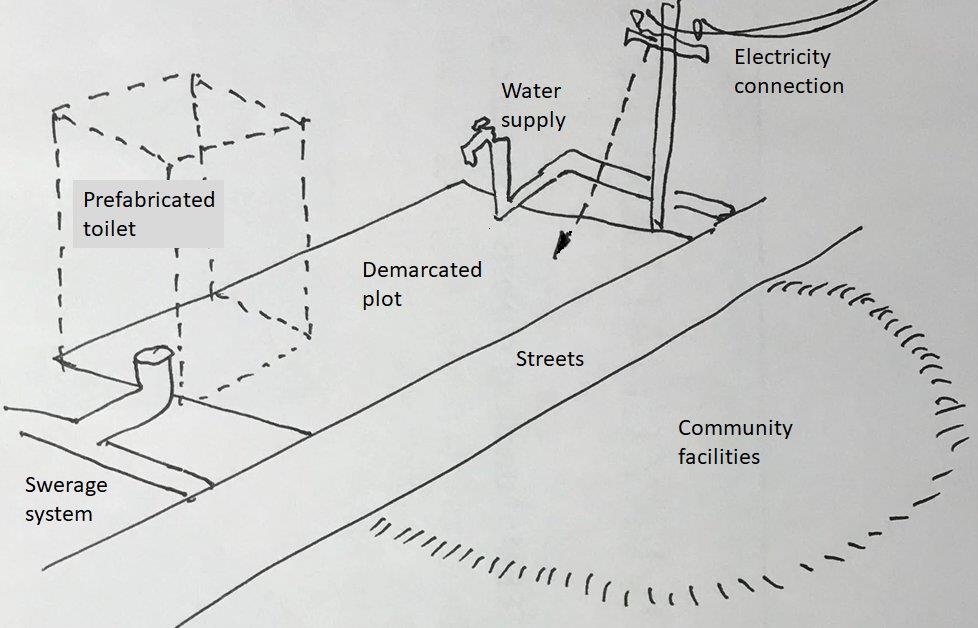
Thus, the sites-and-services approach advocated the role of government agencies only in the preparation of land parcels or plots with certain basic infrastructure, which was to be sold or leased to the intended beneficiaries. The next step of actual house building was left to the beneficiaries themselves to use their own resources, such as informal finance or family labour and various other types of community participation modes to build their house. The beneficiaries could also build the house at their own phase, depending on the availability of financial and other resources. This adopted the basic principle of the development of a squatter settlement but without the "squatting" aspect.
Depending on the investment made, resources available, the implementing agency or degree of organization of the beneficiaries, sites-and-services schemes were activated in a number of differing ways. This variation was a result of the attempt to strike a balance between minimum "acceptable" housing conditions and affordability of the beneficiaries. While following the basic rule of a plot of land (sites) and essential infrastructure (services), the degree of participation and inputs of the implementing agency on one hand, and the beneficiaries on the other, varied greatly. They ranged from an empty plot of land and some services (like water, electricity and sanitation connections) to the provision of a "core" house (consisting of a toilet and kitchen only) on the plot of land with attached services.
Some of the variations attempted in sites-and-services projects include:
The two key actors in a sites-and-services project are the intended beneficiaries and the implementing agency. In most cases, the intended beneficiaries of the project belong to the lower income group of an urban area - for example, squatters who have been relocated from their original illegal settlement. They are characterized by low incomes, informal sector jobs or irregular employment and lack the necessary assets to enable them to afford a "formal" sector house. With basic skills in construction, many are in a position to build their own house (there are however exceptions to these features - which have resulted in the failure of many sites-and-services schemes).
The other principle actor in the sites-and-services schemes is the implementing agency. In most cases, this is a government department or similar body, like the Housing Boards. Operating from goals and objectives on a city-wide scale and for all income groups, such agencies initiate sites-and-services schemes both for the provision of housing of low-income families as well as removing "eyesores" that squatter settlements depict.
The basic division of the stages of implementation between these two principle actors determines the type of scheme being proposed. Several other actors play essentially supportive roles, including various government agencies responsible for provision of infrastructure, non-governmental or voluntary organizations and so on.
With several assumptions and misconceptions regarding low-income families, sites-and-services projects have been subject to many shortcomings in its conception, identification of beneficiaries, implementation and cost recovery. Thus sites-and-services schemes have often been rendered unaffordable or inaccessible for the lowest-income groups by bureaucratic procedures, institutional requirements and political problems. Some of the constraints have been:
The positive aspect of sites-and-services schemes that deserves support is its recognition of the ability of people to house themselves, with a little backing from the government agencies. Thus the role of the government changes from that of a "provider" to an "enabler". It also enables them to save scarce resources by "sharing" the responsibility of housing with the intended beneficiaries. On the part of the beneficiaries, it makes best use of existing/potential resources, both at the household level as well as the community level. On a large scale, it enables the low-income families to obtain decent housing and services, at levels that can be afforded by them.
While sites-and-services schemes are not a blanket solution for all ills of low-income housing, it does provide potential for future housing, making best use of existing resources, both governmental and household. A number of local conditions and circumstances determine the type and scale of the scheme to be used.
Laquian, Aprodicio A (1983) "Sites, Services and Shelter - an Evaluation" Habitat InternationalVolume 7, Number 5/6, pp. 211-255.
van der Linden, Jan. (1986) The Sites and Services Approach Reviewed. Hants, England: Gower Publishing Co.
Peattie, Lisa R. (1982) "Some Second Thoughts on Sites-and-Services" Habitat International Volume 6, Number 1/2, pp. 131-139.
Swan, Peter J., et.al (1983) Management of Sites and Services Housing Schemes: The Asian Experience. Rotterdam: Institute of Housing Studies.
UNCHS [HABITAT] (1991) The Incremental-Development Scheme - A Case Study of Khuda-ki-Basti in Hyderabad, Pakistan. Nairobi: United Nations Centre for Human Settlements.
World Bank (1974) Sites and Services Projects A World Bank Paper. Washnigton D.C.: The World Bank.
|
on |
 |
Return to Slums and Squatters Adopting a Rational Approach Contact: |

