Urban E-Governance
Artificial Intelligence in Urban E-Governance:
Transforming Digital Cities
Hari Srinivas Concept Note Series E-257

Abstract:
Cities around the world are entering a new phase of digital governance in which artificial intelligence (AI) can play a transformative role. Building on earlier advances in e-governance and smart city technologies, AI introduces a powerful analytical layer capable of processing large volumes of urban data, identifying patterns, and supporting more informed and timely decision making. When applied effectively, AI can enhance service delivery, improve infrastructure management, strengthen environmental monitoring, support public health and safety, and expand opportunities for participatory governance.This concept note examines the key domains in which AI can be applied within urban governance and highlights the ways in which it is reshaping administrative practices. It explores the benefits that AI can offer, including improved efficiency, faster public services, and more evidence based policymaking, while also addressing critical risks such as algorithmic bias, privacy concerns, surveillance risks, and the digital divide. Recognizing that technology alone cannot guarantee better governance, the document emphasizes the need for strong institutional frameworks, ethical safeguards, and public oversight.
The analysis also identifies institutional and policy requirements that cities must address to deploy AI responsibly, including data governance frameworks, procurement standards, accountability mechanisms, and capacity building within municipal administrations. Finally, it proposes a set of strategic questions to guide cities in aligning AI adoption with broader goals of transparency, equity, and sustainability. By approaching AI not merely as a technological innovation but as a governance challenge, cities can harness its potential to advance sustainable development and improve the quality of life for all residents.
Keywords:
artificial intelligence, urban governance, digital cities, e-governance, smart city systems, data governance, algorithmic accountability, sustainable urban development1. Background and Rationale
TThe concept of urban governance has evolved from basic computerization to the digitization of services (e-governance 1.0)E-governance 1.0 is the initial phase of digital government where basic public services and information was delivered online through websites and simple digital platforms. and is now evolving to its next transformation. As cities become hyper-complex ecosystems characterized by very high population density, aging infrastructure, climate volatility, and deep-seated inequalities, traditional governance models are struggling to keep pace. Simultaneously, urban landscapes are also generating vast data ecosystems through IoT sensors, mobile platforms, and administrative databases.There is a pressing need to move beyond simply digitizing analog processes toward creating intelligent, decision-support systems that can understand, predict, and respond to urban dynamics in real-time. This concept note positions Artificial Intelligence (AI) not as a replacement for existing e-governance, but as the critical intelligence layer built upon it, a layer that can synthesize fragmented data, automate complex tasks, and provide the foresight necessary for building resilient, responsive, and equitable digital cities.
2. Defining AI in the Context of Urban Governance
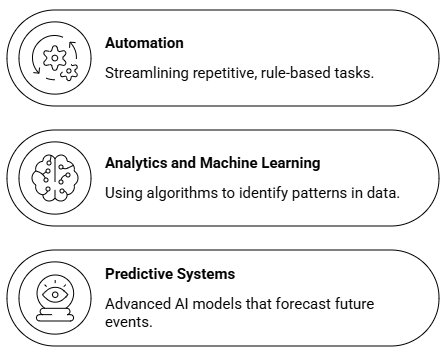
In public administration, Artificial Intelligence refers to the capability of machines to perform tasks that typically require human intelligence (such as learning, reasoning, and problem-solving) when applied to civic challenges. It is crucial to distinguish between its various forms:AI is the cognitive engine of the broader "smart city" ecosystem. It gives meaning to the data collected by the Internet of Things (IoT) and provides the analytical power required to turn Big Data into actionable intelligence. For instance, Singapore utilizes AI and data analytics for predictive urban planning and dynamic traffic management, while Barcelona has pioneered the use of digital platforms and sensor data to create a more integrated and responsive urban governance model.
- Automation: Streamlining repetitive, rule-based tasks (e.g., form processing).
- Analytics and Machine Learning (ML): Using algorithms to identify patterns in data to generate insights (e.g., predicting traffic congestion) without being explicitly programmed for every scenario.
- Predictive Systems: Advanced AI models that forecast future events based on historical and real-time data (e.g., predicting disease outbreaks).
Figure 1: AI in Urban GovernanceThis Concept Note is based on analysis of AI strategies of six cities around the world, summarized at the end of section 3.
3. Five Key Domains of AI Application in Cities
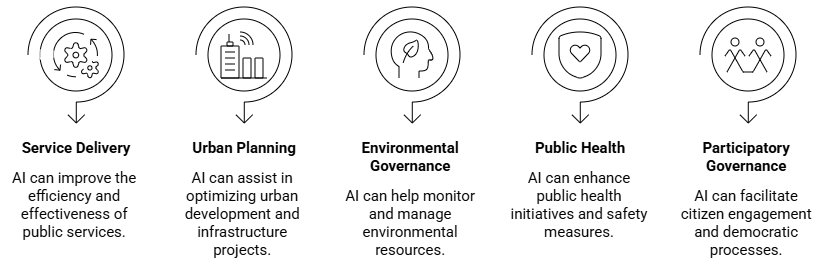
AI's potential can be organized across several core governance functions that shape how cities deliver services, manage infrastructure, and engage citizens. Each of the five domains outlined below represents a critical function of urban governance where AI can create significant public value.Figure 2 below highlights five key domains where artificial intelligence is reshaping urban systems and governance. In service delivery, AI enhances the efficiency, responsiveness, and targeting of public services, enabling governments to better meet citizen needs. In urban planning, it supports data-driven decision-making by optimizing land use, infrastructure development, and mobility systems.
Environmental governance also benefits from AI through real-time monitoring, predictive analytics, and improved management of natural resources and urban ecosystems. In public health, AI strengthens disease surveillance, emergency response, and the design of preventive health measures, contributing to safer and more resilient cities.
Finally, participatory governance is enriched by AI-enabled platforms that facilitate citizen engagement, feedback, and more inclusive democratic processes. Together, these domains illustrate how AI acts as a cross-cutting enabler for smarter, more adaptive, and citizen-centric urban development.
Figure 2: Five Domains of AI in Cities
DOMAIN 1: Service Delivery Service delivery is often the most visible interface between citizens and government, shaping perceptions of efficiency, responsiveness, and trust. AI has the potential to transform this interface by automating routine processes, improving response times, and enabling more personalized and accessible public services. By streamlining administrative workflows, AI can help cities deliver faster, more reliable, and citizen centric services at scale. Automated Grievance Redress Systems: AI based systems can automatically classify and route citizen complaints to the appropriate municipal department. By identifying the nature and urgency of each grievance, these platforms help accelerate response times and reduce administrative bottlenecks.
AI Chatbots for Citizen Services: AI powered chatbots can function as round the clock virtual assistants that provide citizens with instant information about permits, public programmes, and civic services. By handling routine queries automatically, they significantly reduce pressure on call centers and frontline administrative staff.
Intelligent Document Processing: AI systems can extract, verify, and organize information from submitted applications such as licenses, permits, or identity documents. This automation significantly shortens processing times while reducing human error in document verification.
Together, these applications demonstrate how AI can transform service delivery into a faster, more responsive, and citizen centric system that improves both administrative efficiency and user experience.
DOMAIN 2: Urban Planning and Infrastructure Urban planning and infrastructure management require the coordination of complex systems that are constantly evolving. AI enables cities to move from static planning approaches to more dynamic, data driven models that respond to real time conditions. By optimizing mobility, energy, and water systems, AI can support more efficient, resilient, and sustainable urban development. Traffic Prediction and Mobility Optimization: AI models can analyze real time traffic data from sensors, cameras, and mobile devices to identify congestion patterns across urban road networks. These insights allow city authorities to optimize signal timings and improve routing for both private vehicles and public transport.
Energy Demand Forecasting: Predictive analytics powered by AI can anticipate fluctuations in electricity demand based on historical consumption patterns, weather conditions, and human activity. This enables utilities to balance grid loads more efficiently while integrating renewable energy sources.
Water System Leak Detection: Machine learning algorithms can analyze acoustic signals and sensor data within water distribution systems to detect early signs of leakage. Early detection enables utilities to undertake timely repairs and prevent major infrastructure failures or water losses.
Collectively, these tools illustrate how AI can enable more adaptive and data driven management of urban systems, supporting cities in building infrastructure that is efficient, resilient, and sustainable.
DOMAIN 3: Environmental Governance Environmental governance is becoming increasingly critical as cities face growing pressures from climate change, pollution, and resource constraints. AI provides powerful tools for monitoring environmental conditions, predicting risks, and supporting proactive interventions. These capabilities enable cities to strengthen resilience, improve environmental quality, and make more informed long term sustainability decisions. Air Quality Prediction: AI systems can generate hyperlocal forecasts of pollution levels by combining environmental monitoring data with meteorological information. These forecasts allow authorities to issue health advisories and implement targeted measures such as temporary traffic restrictions.
Flood Early Warning Systems: AI can integrate rainfall data, weather forecasts, river levels, and drainage information to identify areas at risk of flooding. By improving the accuracy and timeliness of warnings, cities can better protect vulnerable communities and infrastructure.
Climate Risk Modeling: AI based simulations can analyze long term climate scenarios including rising temperatures, urban heat island effects, and sea level rise. These insights help policymakers design more resilient zoning regulations and infrastructure investments.
These applications highlight the potential of AI to shift environmental governance from reactive management toward proactive and predictive approaches that strengthen urban resilience.
DOMAIN 4: Public Health and Safety Ensuring public health and safety is a core responsibility of urban governments, requiring timely information and coordinated responses. AI enhances these capabilities by enabling early detection of risks, faster emergency response, and more effective monitoring of urban environments. When implemented responsibly, these systems can significantly improve the protection and wellbeing of urban populations. Disease Outbreak Detection: AI tools can monitor anonymized data from search queries, social media trends, and pharmacy purchases to identify unusual health patterns. Detecting these signals early enables public health authorities to respond more quickly to emerging disease outbreaks.
Emergency Response Optimization: AI systems can analyze historical incident data together with real time information to determine the fastest routes for emergency responders. This helps police, fire, and ambulance services reach incident locations more rapidly and coordinate responses more effectively.
Smart Surveillance with Safeguards: AI powered video analytics can detect unusual activities in public spaces such as abandoned objects or dangerous crowd movements. However, such systems must be implemented with strong safeguards to protect privacy and uphold civil liberties.
Taken together, these innovations show how AI can enhance the capacity of cities to anticipate risks, respond more effectively to emergencies, and safeguard public wellbeing.
DOMAIN 5: Participatory Governance Participatory governance focuses on strengthening the role of citizens in shaping public decisions and policies. AI can expand these opportunities by enabling governments to process large volumes of public input, simulate policy outcomes, and make complex information more accessible. By enhancing transparency and engagement, AI can support more inclusive, informed, and responsive governance processes. AI Assisted Policy Simulations: AI models can simulate the potential social, economic, and environmental impacts of proposed policies before they are implemented. This allows policymakers to compare alternative scenarios and anticipate unintended consequences.
Sentiment Analysis of Citizen Feedback: AI tools can analyze large volumes of citizen feedback from social media platforms, surveys, and public consultations. These analyses help governments better understand public concerns and identify emerging policy priorities.
Digital Participatory Budgeting Platforms: AI enabled platforms can help citizens visualize how different budget allocations affect public services and infrastructure. By making complex tradeoffs easier to understand, these tools encourage more informed and meaningful public participation.
Overall, these tools demonstrate how AI can deepen democratic engagement by making governance more transparent, participatory, and responsive to citizen needs.
Artificial intelligence can support multiple dimensions of urban governance. The table below summarizes key governance domains, typical AI applications, and the public objectives they support.
Table 1: Domains, Applications, and Governance Objectives of Artificial Intelligence in Urban Governance
Domain AI Applications Governance Objective Service Delivery Automated grievance redress systems; AI chatbots for citizen services; intelligent document processing systems. Improve the speed, accessibility, and efficiency of public services while reducing administrative workload. Urban Planning and Infrastructure Traffic prediction and mobility optimization; energy demand forecasting; water system leak detection. Enhance infrastructure management, improve operational efficiency, and support sustainable urban systems. Environmental Governance Air quality prediction; flood early warning systems; climate risk modeling. Strengthen environmental monitoring, support climate adaptation, and improve urban resilience. Public Health and Safety Disease outbreak detection; emergency response optimization; smart surveillance systems with safeguards. Improve public safety, enhance emergency preparedness, and strengthen rapid response capabilities. Participatory Governance AI assisted policy simulations; sentiment analysis of citizen feedback; participatory budgeting platforms. Expand citizen participation and support more inclusive, transparent, and evidence-informed governance. Cities around the world are already experimenting with AI in different areas of urban governance. The following examples illustrate how these technologies are being applied in practice:
Seoul - AI Based Public Service Platforms
Seoul has implemented AI chatbots within its municipal digital service platform to provide residents with instant access to government information. Citizens can inquire about administrative procedures, local regulations, and public services at any time. The system has significantly reduced the burden on municipal call centers while improving service accessibility.Singapore - Predictive Traffic and Urban Planning
Singapore has integrated AI and advanced analytics into its Smart Nation programme to improve urban mobility and infrastructure planning. Traffic data from sensors, GPS devices, and cameras are analyzed in real time to optimize signal timing and manage congestion. The government also uses predictive models to simulate long term urban growth and guide land use planning decisions.Jakarta - AI for Flood Prediction
Jakarta has experimented with AI supported flood prediction systems that combine weather forecasts, river level sensors, and satellite data. The system helps authorities identify areas at risk of flooding and coordinate emergency responses more effectively. Such predictive tools are particularly valuable for rapidly growing cities facing climate related risks.New York City - AI for Building Safety Inspections
New York City has used machine learning to identify buildings most at risk of illegal construction or safety violations. By analyzing historical inspection records and other urban data, the system helps inspectors prioritize which buildings should be checked first. This data driven approach has improved enforcement efficiency and helped prevent potential safety hazards.Barcelona - Data Driven Urban Services
Barcelona has developed a sophisticated urban data platform that integrates information from multiple city systems. AI supported analytics help the city manage services such as waste collection, parking, and water use more efficiently. The city has also emphasized citizen data rights and transparency, making it a leading example of responsible digital governance.Amsterdam - Algorithm Transparency and Ethical AI
Amsterdam has introduced one of the world's first public registers of algorithms used by government agencies. This system allows citizens to see which algorithms are being used in public decision making and how they affect services. The initiative is part of a broader effort to ensure transparency, accountability, and protection of human rights in AI deployment.Table 2: Case Snapshot Grid:
Real World Examples of AI Applications Across Key Urban Governance Domains
City Governance Domain AI Application Seoul Service Delivery AI powered chatbots provide residents with instant access to public service information, improving accessibility and reducing pressure on call centers. Singapore Urban Planning and Infrastructure AI driven analytics optimize traffic flows and support long term infrastructure planning using real time mobility data. Jakarta Environmental Governance AI supported flood prediction systems integrate weather, river, and satellite data to improve risk identification and response. New York City Public Health and Safety Machine learning models identify buildings at risk of safety violations, enabling more targeted inspections and prevention. Barcelona Participatory Governance AI supported platforms analyze citizen feedback and urban data to inform policy decisions and improve civic participation. Amsterdam Participatory Governance A public algorithm registry enhances transparency by allowing citizens to understand how AI systems influence government decisions. 4. Governance Transformation Dimensions
The integration of artificial intelligence into urban governance is not simply a technological upgrade but a fundamental shift in how public institutions operate and make decisions. By enabling real time data analysis, predictive insights, and automated processes, AI is reshaping the core logic of governance systems. This transformation affects how cities anticipate challenges, coordinate across departments, monitor performance, and support decision making, marking a transition toward more adaptive, integrated, and intelligence driven forms of governance.
- From Reactive to Predictive Governance:
AI enables governments to anticipate emerging problems rather than responding only after crises occur. By analyzing large datasets and identifying patterns, predictive systems allow authorities to take preventive action before challenges escalate.
- From Siloed Departments to Integrated Data Systems:
Traditional municipal departments often operate independently, which can limit coordination and information sharing. AI enabled platforms can integrate datasets across sectors, enabling more holistic and cross sectoral decision making.
- From Periodic Reporting to Real Time Monitoring:
Conventional governance systems rely on periodic reports that often provide delayed snapshots of urban conditions. AI driven monitoring tools enable continuous tracking of city operations and allow managers to respond quickly to emerging issues.
- From Manual Bureaucracy to Algorithmic Decision Support:
AI can automate repetitive administrative tasks and generate analytical insights for policymakers. This allows public officials to focus more on strategic planning, complex problem solving, and citizen engagement.
5. Benefits and Opportunities
The adoption of artificial intelligence in urban governance presents a wide range of opportunities to improve the effectiveness and quality of public administration. By enhancing efficiency, accelerating service delivery, and enabling more informed decision making, AI can help cities respond more effectively to growing urban complexities. At the same time, these benefits extend beyond operational improvements to include greater transparency, stronger citizen engagement, and more inclusive governance processes.
- Improved Efficiency and Cost Savings:
AI can automate routine administrative functions and optimize the allocation of resources across public services. These efficiencies can reduce operational costs in areas such as energy management, water distribution, and municipal fleet operations.
- Faster and More Responsive Services:
AI supported systems can streamline bureaucratic procedures and reduce delays in service delivery. As a result, citizens can receive permits, licenses, and grievance responses more quickly.
- Evidence Based Policymaking:
AI allows governments to analyze large and complex datasets to generate reliable insights for policy decisions. This strengthens policymaking by grounding decisions in empirical evidence rather than intuition or short term political pressures.
- Enhanced Transparency:
AI powered open data platforms can make government performance information more accessible to the public. By enabling citizens to track service delivery and policy outcomes, these systems strengthen accountability.
- Potential for More Inclusive Engagement:
AI tools can analyze feedback from a wide range of sources including digital platforms, surveys, and online consultations. This allows governments to capture a broader and more representative range of citizen perspectives than traditional participation methods.
6. Risks and Ethical Concerns
While artificial intelligence offers significant potential for improving urban governance, it also introduces a set of complex risks and ethical challenges that must be addressed proactively. The use of large scale data, automated decision making, and predictive systems raises important questions related to fairness, accountability, privacy, and social equity. Ensuring that AI is deployed responsibly requires careful consideration of these risks and the establishment of safeguards that protect citizens while maintaining public trust.
- Algorithmic Bias and Discrimination:
AI systems trained on biased historical data may reproduce or amplify existing social inequalities. This can lead to discriminatory outcomes in areas such as housing allocation, policing, or access to public services.
- Privacy and Data Protection:
The large scale collection of urban data raises serious concerns about the protection of personal information. Without robust safeguards, sensitive data may be misused, exposed, or exploited for surveillance purposes.
- Surveillance Risks:
AI enabled monitoring technologies can significantly expand the capacity of governments to track individual behavior in public spaces. If poorly regulated, such systems may undermine civil liberties and discourage free expression.
- Lack of Transparency:
Many AI systems function as complex "black box" models whose decision making processes are difficult to interpret. This lack of transparency can make it challenging for citizens and officials to understand or challenge algorithmic decisions.
- Digital Divide:
AI driven digital services often assume that citizens have reliable internet access and adequate digital literacy. Communities without these resources risk exclusion from essential services.
- Over reliance on Private Tech Vendors:
Cities may become dependent on proprietary AI platforms provided by a small number of technology companies. This dependence can lead to vendor lock in and reduce public control over critical digital infrastructure, highlighting the importance of governance models such as the public algorithm registry initiative emerging in Amsterdam.
7. Institutional and Policy Requirements
Realizing the benefits of artificial intelligence while managing its risks requires more than technological adoption; it demands a strong institutional and policy foundation. Cities must develop governance frameworks that ensure responsible data use, transparent decision making, and accountability in algorithmic systems. This includes building internal capacity, establishing regulatory mechanisms, and creating oversight structures that can guide the ethical and effective deployment of AI in public administration.
- Legal Frameworks for Data Governance:
Clear legal frameworks must define how urban data is collected, stored, shared, and protected. These frameworks should prioritize citizen rights, privacy protection, and responsible data stewardship.
- AI Procurement Standards:
Public procurement processes should require technology vendors to demonstrate transparency, fairness, and strong data security practices. Embedding such requirements in tender procedures helps ensure ethical design from the outset.
- Algorithmic Accountability Mechanisms:
Cities should introduce procedures to evaluate the social and ethical impacts of AI systems before they are deployed. Algorithmic impact assessments and independent audits can help identify potential bias and ensure accountability.
- Capacity Building:
Municipal staff need training not only to operate AI tools but also to critically evaluate their outputs and limitations. Strengthening internal expertise allows governments to manage vendor relationships effectively and maintain strategic control over technology deployment.
- Public Oversight and Audit Systems:
Independent oversight bodies should monitor how AI technologies are used within public administration. Including representatives from civil society and academia can strengthen transparency and build public trust.
8. AI, E Governance, and Sustainable Development
Artificial intelligence has the potential to play a critical role in advancing sustainable development within urban contexts. By improving resource efficiency, supporting climate adaptation, and enabling more inclusive decision making, AI can contribute directly to achieving broader sustainability goals. When aligned with principles of equity and long term resilience, AI can serve as a powerful tool for helping cities transition toward more sustainable, inclusive, and future ready development pathways.
- Contribution to SDGs:
AI technologies can directly support Sustainable Development Goal 11 by improving the efficiency and sustainability of urban systems. They can also contribute to SDG 13 by enabling predictive modeling that strengthens climate resilience.
- AI for Climate Action and Resilience:
AI applications can help cities optimize energy systems, improve resource management, and anticipate environmental risks such as flooding or extreme heat. These capabilities enable governments to design policies and infrastructure that better adapt to climate change.
- Equity Centered AI Deployment:
AI systems can be designed intentionally to identify service gaps and highlight underserved populations. By directing attention and resources toward marginalized communities, cities can ensure that digital transformation contributes to greater social equity.
Key Takeaway
Artificial intelligence has the potential to significantly improve how cities deliver services, manage infrastructure, and respond to complex urban challenges. Yet its true value lies not in technological sophistication but in responsible governance.Cities that succeed with AI will be those that clearly define public value goals, establish strong data governance systems, and ensure transparency, accountability, and inclusion. When guided by these principles, AI can help create urban systems that are not only smarter, but also more resilient, equitable, and sustainable.
9. Strategic Questions for Cities
As cities begin to explore the integration of artificial intelligence into governance, the central challenge is not simply technological adoption but strategic and ethical deployment. The following questions can serve as a guide for policymakers and city leaders as they navigate the opportunities and risks of AI enabled governance.
- What specific public value problems are we trying to solve with AI?
Cities should begin with clearly defined public challenges rather than with the technology itself. AI should be applied where it can demonstrably improve outcomes for citizens and strengthen public value.
- Do we have the necessary data quality and governance structures to support AI systems?
AI systems depend on reliable, well managed data to function effectively. Without strong data governance and high quality datasets, even the most advanced technologies will produce weak or misleading results.
- Who owns the data generated by citizens, public services, and urban sensors, and how is that ownership protected?
Questions of data ownership and control are central to digital governance. Cities must ensure that data sovereignty is clearly defined and that citizens' rights over their personal information are protected.
- How can fairness, accountability, and transparency be ensured in the algorithms that cities deploy?
Ethical safeguards must be built into AI systems from the outset rather than added later. Mechanisms such as algorithm audits, transparency standards, and clear accountability frameworks are essential for maintaining public trust.
- What internal capacity must governments develop to act as informed and responsible users of AI?
Municipal institutions need the expertise to evaluate technologies, manage vendor relationships, and interpret algorithmic outputs. Building such capacity helps cities remain strategic partners in digital innovation rather than passive consumers of private technology.
- How should success be measured when AI is introduced into urban governance?
Performance metrics should go beyond efficiency gains or cost reductions. Cities must also evaluate whether AI improves equity, strengthens public trust, and enhances overall quality of life.
- Who might be excluded from AI driven services, and how can those risks be mitigated?
Digital transformation can unintentionally deepen existing inequalities if vulnerable populations are overlooked. Inclusive design and proactive outreach are therefore essential to ensure that the benefits of AI reach all residents. Together, these questions highlight that the future of AI in cities is not only a technological issue but also a governance challenge. Cities that approach AI with clarity of purpose, strong ethical frameworks, and inclusive institutional capacity will be better positioned to harness its benefits while safeguarding democratic values.
Closing Reflection: Governing the Intelligent City
Artificial intelligence offers cities an unprecedented opportunity to improve service delivery, strengthen infrastructure management, and make governance more responsive and evidence based. Yet the true transformation lies not in the technology itself, but in how institutions choose to deploy it.Cities that succeed in the AI era will be those that approach technology with clear public purpose, strong data governance, and robust ethical safeguards. Building institutional capacity, ensuring transparency, and protecting citizen rights will be just as important as technical innovation.
Ultimately, the goal of AI enabled governance is not simply smarter cities, but fairer, more resilient, and more inclusive urban societies. When guided by these principles, AI can become a powerful tool for advancing sustainable development and improving the quality of life for all urban residents.
A Call to Action for Cities
Cities stand at an important moment in the evolution of digital governance. Artificial intelligence offers powerful tools for addressing urban challenges, but its benefits will only be realized if it is deployed with foresight, responsibility, and a strong commitment to public value.Urban leaders must therefore move beyond experimentation and develop clear strategies for ethical and inclusive AI deployment. This means investing in institutional capacity, strengthening data governance frameworks, safeguarding citizen rights, and ensuring that digital innovation serves the needs of all residents.
By approaching AI not simply as a technology but as a governance challenge, cities can harness its potential to build more sustainable, resilient, and inclusive urban futures.
This work by GDRC is licensed under a Creative Commons Attribution-ShareAlike 4.0 International License. You are free to share and adapt this piece of work for your own purposes, as long as it is appropriately citied. . More info: http://creativecommons.org/licenses/by-sa/4.0/
on
Return to E-Governance
Contact: