
Environmental Decision-Making Tool: The GET Matrix
Hari Srinivas GDRC Portal Series F-102
Abstract
The GET Matrix is a decision-support framework developed by GDRC for analysing complex environmental problems. It structures intervention actions along three dimensions: Governance (rules, institutions, policy frameworks), Education (awareness-raising, capacity-building, learning) and Technology (technical systems, competencies, innovation) and applies them across global, national and local levels. By placing actors and interventions into this matrix, stakeholders can identify gaps, synergies and multi-level pathways for sustainable action.Keywords
GET Matrix, environmental decision-making, governance education technology, multi-level policy framework, stakeholder collaboration, sustainable development, climate change policy, decision-support toolThe GET Matrix: A Framework for Action
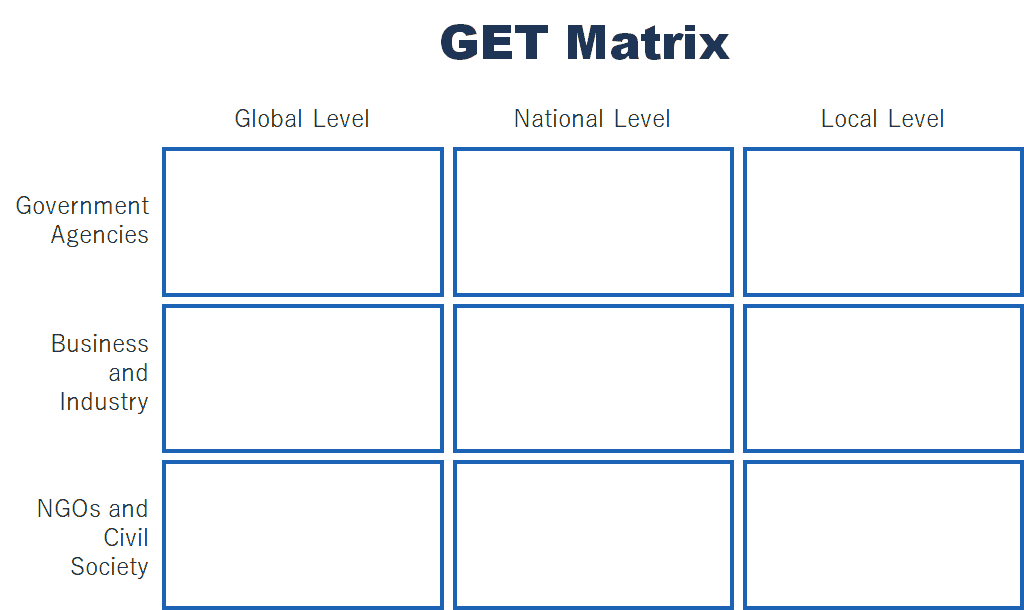
The GET Matrix (Governance, Education, and Technology Matrix) is a policy analysis framework designed to address complex problems by categorizing actions across three key themes-governance, education, and technology-while considering the roles of different actors.
The matrix is structured with three columns representing government agencies, business and industry, and civil society (including NGOs and NPOs), and three rows representing global, national, and local levels. Each cell highlights specific actions relevant to the theme, actor, and level, enabling a comprehensive approach to problem-solving.
The GET Matrix (illustrated below) is particularly useful for addressing multifaceted issues like climate change, fostering collaboration among stakeholders, and aligning efforts across scales of governance and responsibility.
Figure 1: The GET MatrixThe GET Matrix is a versatile framework for analyzing and addressing global challenges by aligning governance, education, and technology with the roles of key stakeholders across global, national, and local levels. Its structured approach ensures a comprehensive understanding of how different actors-government agencies, businesses, and civil society - can collaborate effectively to implement solutions. By categorizing actions, the matrix highlights synergies and gaps, fostering more strategic policymaking and resource allocation.
Beyond climate change, the GET Matrix is equally applicable to other pressing environmental issues, such as biodiversity loss and desertification. For instance, in biodiversity conservation, the matrix can guide global governance through treaties such as the Convention on Biological Diversity, national education initiatives to raise awareness of species protection, and local technology-driven conservation efforts such as drone monitoring of ecosystems.
Similarly, for desertification, the framework helps coordinate global agreements such as the UN Convention tp COmbact Deesertification (UNCCD), national policies to promote sustainable land management, and local community education programs to combat soil degradation. By emphasizing interconnected actions, the GET Matrix supports holistic solutions to environmental challenges, ensuring progress across scales and sectors.
There are a number of documents across the 15 research programmes of GDRC that have illustrated the use of the GET Matrix for policy analyses and action. A selection of documents are listed below:
GDRC Publications Referencing the GET Matrix
Environmental Decision-Making Programme
- Introduction: Environmental Decision-Making
https://www.gdrc.org/decision/introduction.html- Framework for Climate Action: The GET Matrix for Climate Change Policies
https://www.gdrc.org/decision/GET-climate.html- A Decision Support Tool for Sustainable Building and Construction: The GET Matrix
https://www.gdrc.org/uem/green-const/get-matrix.html- Intrapolation and Extrapolation: The dilemma of Global Policy-Making
https://www.gdrc.org/decision/intra-extra/index.htmlSustainable Development Programme
- A Quick Introduction to Circular Economies
https://www.gdrc.org/sustbiz/circular-economy.html- Carbon, Carbon, Everywhere: A Lexicon of Carbon Terms
https://www.gdrc.org/sustdev/carbon/full-carbon.htmlUrban Environmental Management Programme
- A Decision Support Tool: The GET Matrix
https://www.gdrc.org/uem/green-const/get-matrix.html- Green Construction Resource Kit
https://www.gdrc.org/uem/green-const/tab3-action.htmlUrban Governance Programme
- Enhancing Urban Governance: Integrating Multi-stakeholder Analysis into the GET Matrix
https://www.gdrc.org/u-gov/multistakeholder-GET.htmlUrban Heritage and Conservation Programme
- Prioritizing Cultural Heritage in the Asia-Pacific Region: Role of City Governments
https://www.gdrc.org/heritage/heritage-priority.htmlNGOs and Civil Society Programme
- The Post-2015 Development Agendas: A Comprehensive Framework for Global Action
https://www.gdrc.org/ngo/post-2015/ww-more.htmlGender and Development Programme
- Gender and E-Waste: Policy Considerations for Developing Countries
https://www.gdrc.org//gender/gender-ewaste/index.htmlInformal Sector Programme
- Four Corners of Policies for the Informal Sector: A Framework for Sustainable Development and Integration
https://www.gdrc.org/informal/four-corners.htmlTechnology Management Programme
Sustainable Business Programme
- A Quick Introduction to Circular Economies
https://www.gdrc.org/sustbiz/circular-economy.htmlKnowledge Management Programme
- Knowledge Management for Problem Solving: Think Solutions https://www.gdrc.org/kmgmt/think.html
Global-Local HubThe hub presents a set of GDRC research initiatives, which explore the inheret interlinkages between global initiatives, and its local implications on lifestyle choices and consumption patterns.
Info Repository on MEAs Post-2015 Agendas The GET Policy Matrix MEAs and the Urban Arena The Trialogue: Big Three Global Goals, Local Action
This work by GDRC is licensed under a Creative Commons Attribution-ShareAlike 4.0 International License. You are free to share and adapt this piece of work for your own purposes, as long as it is appropriately cited. More info: http://creativecommons.org/licenses/by-sa/4.0/
on


 |
Environmental Decision-Making Contact:
|